 ChatgptApp Việt Nam
Expanding a brand across multiple countries creates valuable commercial opportunities, but it also increases the risk of conflicting trademarks, bad-faith filings, unauthorized distribution, and counterfeiting. Trademark rights are territorial, which means registration in one country does not automatically protect a brand everywhere else. Working with a global trademark attorney can help businesses evaluate trademark availability, select priority jurisdictions, coordinate international filings, respond to legal objections, and build a portfolio that supports long-term expansion.
What Is a Global Trademark Attorney?
A global trademark attorney is a legal professional who helps businesses protect and manage trademarks across multiple countries and regions.
Unlike a filing service focused only on submitting applications, a global trademark attorney considers the broader legal and commercial strategy behind international brand protection.
The attorney may advise on:
- Brand selection;
- International trademark searches;
- Registrability assessment;
- Country selection;
- National and regional filings;
- Madrid System applications;
- Trademark ownership;
- Licensing and assignments;
- Provisional refusals;
- Opposition proceedings;
- Portfolio monitoring;
- Enforcement and anti-counterfeiting actions.
The objective is to create a coordinated trademark strategy rather than a collection of unrelated registrations.

Why Do Businesses Need Global Trademark Protection?
A trademark identifies the commercial source of goods or services. It may include a business name, product name, logo, slogan, symbol, label, packaging element, or another distinctive sign.
When a business enters international markets without trademark protection, it may have limited legal options against third parties using or registering similar branding.
Trademark Rights Are Territorial
A trademark registration normally applies only within the jurisdiction where it was granted.
For example, a registration obtained in Vietnam does not automatically provide protection in the United States, China, Japan, the European Union, or other markets.
Businesses must therefore obtain protection in the countries or regions that are relevant to their operations.
Priority territories may include:
- Current sales markets;
- Planned expansion markets;
- Manufacturing countries;
- Distribution territories;
- Franchise locations;
- E-commerce markets;
- Countries associated with counterfeiting.
First-to-File Risks
Many jurisdictions give significant importance to the party that files a trademark application first.
This creates a risk that a distributor, manufacturer, competitor, former partner, or unrelated third party may register the brand before the original owner.
Recovering a trademark after a bad-faith filing may require an opposition, cancellation action, negotiation, transfer agreement, or court proceeding.
Early filing is usually less costly than attempting to recover the mark later.
International Brand Consistency
A company may use one brand in several countries, but legal availability may differ between markets.
A mark that is registrable in one jurisdiction may conflict with an earlier right elsewhere.
A global attorney can help determine whether the business should:
- Use the same brand worldwide;
- Modify the mark in selected countries;
- Adopt a local-language version;
- Register multiple brand variations;
- Avoid certain markets;
- Negotiate with an earlier rights holder.
This planning helps maintain commercial consistency while respecting local legal conditions.
What Does a Global Trademark Attorney Do?
The scope of work depends on the business model, target markets, and value of the brand.
Evaluate the Brand Portfolio
The attorney first identifies which trademarks are commercially important.
A business may own or use:
- A company name;
- Product names;
- Service brands;
- Logos;
- Slogans;
- App names;
- Local-language marks;
- Sub-brands;
- Packaging designs.
Not every sign requires immediate registration in every country. The attorney helps prioritize the assets that create the most commercial value or legal risk.
Conduct Global Trademark Searches
A search is an essential step before filing or launching a brand.
A meaningful international search should consider more than exact matches. It may include:
- Similar spelling;
- Similar pronunciation;
- Shared dominant words;
- Translations;
- Transliteration;
- Similar meanings;
- Related goods and services;
- Similar logos;
- Existing commercial use.
Searches may involve global, regional, national, company-name, domain-name, and commercial databases.
The purpose is not to guarantee registration. It is to identify conflicts and support an informed decision.
Assess Registrability
A trademark may face rejection even when no identical earlier mark is found.
Potential objections may involve:
- Lack of distinctiveness;
- Descriptive wording;
- Generic terms;
- Misleading meaning;
- Prohibited symbols;
- Public policy concerns;
- Earlier conflicting rights;
- Local-language problems.
A global trademark attorney evaluates these risks under the laws of the relevant jurisdictions.
Select Priority Countries
Filing in every country is rarely necessary or financially practical.
The attorney helps the business select countries based on:
- Current revenue;
- Expected expansion;
- Manufacturing activity;
- Distribution relationships;
- Counterfeiting risk;
- Investment plans;
- Licensing opportunities;
- Online sales;
- Budget.
A phased strategy may protect core markets first and add additional jurisdictions as the company grows.
Choose the Filing Route
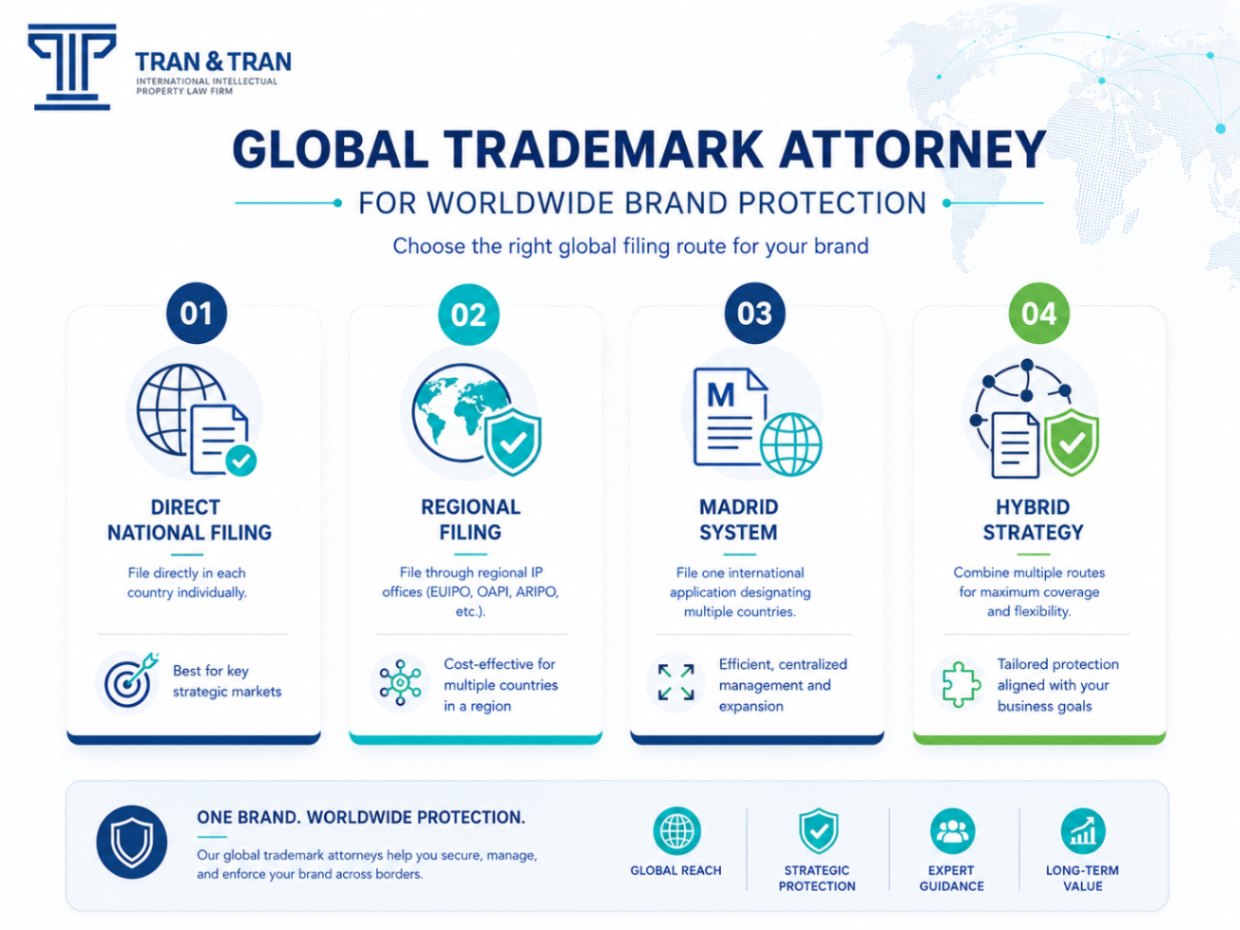
Businesses may use national, regional, or international filing systems.
A global attorney can compare the available routes and recommend the most suitable combination.
National Trademark Applications
A national application is filed directly with the trademark office of one country.
This method may be appropriate when:
- Only one or two markets are involved;
- The jurisdiction is commercially important;
- The trademark presents significant legal risk;
- Local procedures provide strategic advantages;
- A customized specification is needed.
National applications are independently examined and renewed.
The applicant may need local counsel, translations, and separate deadline management.
Regional Trademark Applications
Some systems allow a single application to cover multiple countries.
A regional registration can be cost-effective when a business plans to operate broadly across an integrated market.
However, an earlier right or legal objection affecting part of the region may create complications for the entire application.
The attorney should compare regional and separate national filings before deciding which approach offers better protection.
Madrid System Applications
The Madrid System provides a centralized method for requesting trademark protection in multiple member jurisdictions.
An eligible applicant may file one international application based on an existing national or regional application or registration.
The system can simplify:
- Application filing;
- Fee payment;
- Renewal;
- Ownership changes;
- Address updates;
- Subsequent country designations.
However, the Madrid System does not create one universal trademark.
Each designated trademark office examines the application according to its own law. A mark may be accepted in one country and refused in another.
A global trademark attorney may coordinate the international application and work with local counsel when a designated office issues a provisional refusal.
Combined International Filing Strategies
Many businesses benefit from combining several filing routes.
For example, a company may:
- Use the Madrid System in lower-risk member countries;
- File directly in important markets;
- Use a regional application in Europe;
- Register local-language versions separately;
- Add new countries later.
A combined strategy can balance administrative efficiency, legal flexibility, and cost.
Choosing the Right Trademark Owner
Trademark ownership is especially important in international business structures.
The trademark may be filed in the name of:
- An operating company;
- A holding company;
- A parent company;
- A founder;
- A foreign subsidiary;
- A distributor;
- A joint venture.
Filing in the wrong name can create difficulties during fundraising, licensing, restructuring, enforcement, or sale of the business.
Core trademarks should generally remain under the control of the entity responsible for the long-term brand strategy.
A distributor, local agent, or manufacturer should not register the brand in its own name unless there is a carefully structured legal arrangement.
Selecting Goods and Services
Trademark protection is connected to the goods and services listed in the application.
Most jurisdictions use the Nice Classification, which divides goods and services into 45 classes.
Selecting the class number is only the beginning. The wording of the specification determines the practical scope of protection.
A global trademark attorney may help the business describe:
- Current products;
- Planned product lines;
- Online services;
- Retail activities;
- Software services;
- Licensing activities;
- Franchise services;
- Consulting;
- Manufacturing-related goods.
A specification that is too narrow may leave important activities unprotected. One that is unnecessarily broad may increase fees or create use-related risks.
The Global Trademark Registration Process
Although procedures vary, international trademark work usually follows several common stages.
Step 1: Identify the Trademark
The business determines which name, logo, slogan, or product identifier requires protection.
Word marks and logos may require separate applications.
A word mark often provides broader flexibility for the brand name, while a logo registration protects a specific visual design.
Step 2: Define Business Priorities
The company identifies important markets, manufacturing locations, distributors, customer groups, and future expansion plans.
This information guides the country and filing strategy.
Step 3: Conduct Searches
The attorney searches for identical and similar rights in the relevant jurisdictions.
Search results are evaluated based on territory, goods and services, legal status, market context, and the strength of earlier rights.
Step 4: Assess Risk
The attorney determines whether the proposed mark presents low, moderate, or high risk.
The business may then decide to proceed, modify the mark, narrow the specification, negotiate with an earlier owner, or choose another brand.
Step 5: Confirm Ownership
The correct legal entity is selected as the applicant.
Ownership should align with the company’s corporate, investment, licensing, tax, and enforcement plans.
Step 6: Prepare the Applications
The applications are drafted with accurate owner details, trademark representations, class information, goods and services, and priority claims where relevant.
Step 7: File and Monitor
The attorney files or coordinates filing with the relevant trademark offices and local associates.
Applications are monitored for formal notices, examination reports, publication, opposition, and registration.
Step 8: Respond to Objections
A trademark office may raise issues involving distinctiveness, description, classification, or earlier rights.
The response may require:
- Legal arguments;
- Amendments;
- Evidence;
- Consent agreements;
- Coexistence agreements;
- Limitation of goods;
- Local counsel assistance.
Step 9: Manage Opposition
Third parties may oppose the application after publication.
The attorney evaluates the strength of the opposition, prepares evidence, develops arguments, and considers settlement where appropriate.
Step 10: Maintain the Registration
After registration, the owner must manage renewals, ownership changes, licensing, evidence of use, and enforcement.
Handling Provisional Refusals
A provisional refusal may be issued when a national or regional office objects to an international trademark designation.
Possible grounds include:
- Earlier trademarks;
- Descriptiveness;
- Lack of distinctiveness;
- Misleading meaning;
- Classification problems;
- Local formalities;
- Public policy.
The response must usually comply with local law and deadlines.
A global trademark attorney can review the refusal, coordinate with local counsel, and decide whether to submit arguments, amend the specification, provide evidence, or negotiate with an earlier owner.
Trademark Oppositions Across Borders
Trademark opposition is a formal procedure through which a third party challenges a pending application.
An opposition may be based on:
- Earlier registration;
- Earlier pending application;
- Prior use;
- Reputation;
- Bad-faith filing;
- Company name rights;
- Copyright;
- Other commercial rights.
International oppositions can be complex because the legal standards, evidence rules, and deadlines differ between jurisdictions.
Possible outcomes include:
- Withdrawal;
- Limitation of goods and services;
- Consent agreement;
- Coexistence agreement;
- Settlement;
- Formal opposition decision.
The business should evaluate both legal strength and commercial importance before deciding how aggressively to defend an application.
Trademark Licensing in International Markets
Licensing allows another party to use a trademark under agreed conditions.
An international trademark license should address:
- Territory;
- Products and services;
- Duration;
- Quality control;
- Royalties;
- Marketing standards;
- Sub-licensing;
- Enforcement;
- Ownership;
- Termination;
- Post-termination obligations.
Quality control is important because inconsistent use can damage the reputation and distinctiveness of the brand.
Some jurisdictions may also require or recommend recording the license with the relevant trademark authority.
International Trademark Assignments
An assignment transfers ownership of a trademark from one party to another.
Assignments may occur during:
- Mergers;
- Acquisitions;
- Corporate restructuring;
- Founder transfers;
- Brand sales;
- Portfolio consolidation;
- Joint ventures.
A global portfolio may require separate ownership recordals in multiple jurisdictions.
Failure to update official records can create problems during renewal, enforcement, licensing, financing, or sale.
Monitoring Global Trademark Portfolios
Registration does not automatically prevent later conflicting applications or unauthorized use.
Businesses should monitor:
- New trademark filings;
- Company names;
- Domain names;
- Social media;
- E-commerce marketplaces;
- App stores;
- Distributor activities;
- Counterfeit products;
- Online advertising.
A watching service can identify potentially conflicting applications during the opposition period.
Early detection is important because legal options may become more expensive after a conflicting mark is registered and used.
Enforcing Trademark Rights Internationally
When infringement is discovered, the owner may have several options.
Possible actions include:
- Cease-and-desist letters;
- Trademark opposition;
- Cancellation proceedings;
- Customs recordation;
- Marketplace complaints;
- Domain name disputes;
- Administrative enforcement;
- Civil litigation;
- Criminal complaints where applicable;
- Negotiated settlements.
The correct strategy depends on the territory, evidence, urgency, infringer, commercial harm, and strength of the trademark rights.
A global trademark attorney helps coordinate enforcement while maintaining consistent positions across countries.
Global Trademark Support for Startups
Startups often expand internationally through software, e-commerce, digital platforms, and remote services.
A startup may reach foreign users before establishing a local office.
Priority trademark assets may include:
- Company name;
- Platform name;
- App name;
- Main product name;
- Logo;
- Local-language brand.
Limited budgets require careful prioritization.
A startup may first protect its main brand in the home country, principal customer markets, investor markets, and near-term expansion territories.
Global Trademark Support for Exporters
Exporters should consider trademark protection before shipping products or appointing distributors.
Priority jurisdictions may include:
- Destination markets;
- Manufacturing countries;
- Packaging locations;
- Distribution territories;
- Transit countries;
- Markets with high counterfeit risk.
Filing before commercial disclosure can reduce the risk of a local partner or third party registering the brand first.
Global Trademark Support for E-Commerce Businesses
E-commerce businesses may sell in many countries through one website or marketplace.
However, trademark rights remain territorial.
Online sellers should prioritize:
- Main customer countries;
- Marketplace jurisdictions;
- Fulfilment locations;
- Manufacturing countries;
- Markets with unauthorized resellers;
- Countries where platform enforcement requires local rights.
Trademark registration can support complaints against counterfeit listings and misleading accounts, but owners must still comply with each platform’s evidence requirements.
How Much Does a Global Trademark Attorney Cost?
There is no fixed price for a global trademark attorney.
Costs may depend on:
- Number of countries;
- Number of marks;
- Number of classes;
- Search scope;
- Filing route;
- Official fees;
- Translation;
- Local counsel;
- Office actions;
- Oppositions;
- Licensing;
- Assignments;
- Enforcement;
- Portfolio management.
A basic application in one jurisdiction will usually cost less than a multi-country strategy involving extensive searches and local legal work.
Businesses should request an estimate that distinguishes:
- Official fees;
- Attorney fees;
- Search costs;
- Local counsel fees;
- Translation costs;
- Response fees;
- Opposition costs;
- Renewal costs.
The lowest filing price may not include legal analysis, monitoring, or objection support.
How to Choose a Global Trademark Attorney
Businesses should consider legal experience, international coordination, commercial understanding, communication, and transparency.
Useful questions include:
- Does the attorney manage international portfolios?
- Are searches included?
- How are priority countries selected?
- Does the attorney coordinate local counsel?
- Is Madrid System filing available?
- Are provisional refusals handled?
- Are oppositions and cancellations supported?
- Is monitoring available?
- Can the attorney assist with licensing and assignments?
- How are costs reported?
The attorney should explain both the legal risks and the available commercial options.
Common Global Trademark Mistakes
Filing Only in the Home Country
A domestic registration does not normally protect the brand abroad.
Filing After Market Entry
Public disclosure may allow another party to register the mark first.
Skipping Searches
The brand may conflict with earlier rights in the target country.
Ignoring Local Languages
Translations and transliterations may create conflicts or become commonly used versions of the brand.
Allowing Distributors to Own Core Marks
This can create serious problems when the relationship ends.
Selecting the Wrong Classes
The registration may fail to cover actual or planned business activities.
Using One Filing Route for Every Country
Different markets may require different strategies.
Missing Deadlines
Applications may be refused, abandoned, or left undefended.
Ignoring Use Requirements
Registrations may become vulnerable if they are not used within the required period.
Failing to Monitor
Later applications may weaken the brand’s position if no action is taken.
Conclusion
A global trademark attorney helps businesses protect, manage, and enforce trademarks across countries with different laws, procedures, languages, and commercial conditions.
Professional support may include searches, risk assessment, country selection, national and international filings, Madrid System coordination, refusal responses, oppositions, licensing, assignments, monitoring, and enforcement.
Global trademark protection should begin before a business launches in a foreign market, appoints distributors, manufactures abroad, or invests heavily in international advertising.
Early filing can reduce the risk of bad-faith registrations, infringement claims, counterfeiting, and costly rebranding.
A coordinated global trademark portfolio provides a stronger foundation for exports, e-commerce, licensing, franchising, fundraising, acquisitions, and long-term brand growth.
Frequently Asked Questions
What does a global trademark attorney do?
A global trademark attorney helps businesses search, register, manage, license, transfer, monitor, and enforce trademarks across multiple jurisdictions.
Does one trademark registration provide worldwide protection?
No. Trademark rights are territorial and must be obtained through national, regional, or international filing systems covering the relevant markets.
When should a company file internationally?
Ideally, before launching products, advertising, appointing distributors, manufacturing abroad, or entering a new market.
What is the Madrid System?
The Madrid System is a centralized filing mechanism that allows eligible applicants to request protection in multiple member jurisdictions.
Does the Madrid System guarantee registration?
No. Each designated trademark office examines the application under its own law.
Is a global trademark search necessary?
A search is strongly recommended because it helps identify earlier rights and assess filing and infringement risks.
Can a distributor own the local trademark?
It may be legally possible, but core trademarks should generally remain under the control of the brand owner unless there is a carefully structured agreement.
What happens if a country refuses the application?
The applicant may need to submit arguments, amendments, evidence, consent, or other responses under local procedures.
How many countries should a business select?
The number depends on current sales, expansion plans, manufacturing, distribution, counterfeiting risks, and available budget.
What happens after registration?
The owner should manage renewals, evidence of use, ownership records, licensing, monitoring, and enforcement.
